
Nakuru Sponge City Project in Kenya: Leveraging Nature-Based Solutions for Climate Resilience and Flood Management
Rapid urbanization coupled with the intensification of extreme climate events has exerted unprecedented pressure on the ecological resilience of human settlements. Confronting flash floods, continuous degradation of water quality, and freshwater scarcity, the city of Nakuru in Kenya has abandoned the conventional approach of rapid runoff disposal, instead embracing rainwater as a pivotal lever to restore ecosystems and enhance urban livability.
The Nakuru Sponge City Project is being implemented under the innovative “Water as Leverage” (WaL) program, spearheaded by the Netherlands Enterprise Agency (RVO) alongside the Embassy of the Kingdom of the Netherlands in Kenya. This structured initiative has forged an efficient synergy between the expertise of Dutch firms in integrated water resource management and the participatory mechanisms of local communities.
The Nakuru Sponge City initiative shifts the conventional approach of rapidly channeling and discharging rainwater toward absorbing, storing, naturally treating, and gradually releasing urban runoff.
Three strategic focal areas—Menengai, the Nakuru Central Business District (CBD), and Njoro—were selected following 18 months of interdisciplinary studies to implement nature-based interventions.
The four-pillar interventions focus on ecosystem restoration, nature-based drainage, ecological buffers, and strengthening sustainable urban infrastructure to make projects bankable and investment-ready.
Accelerating urbanization and climate change are placing mounting pressure on cities across Africa. In Nakuru, Kenya, where flash floods, water shortages, and deteriorating water quality are increasingly frequent, an innovative approach to urban management is helping the city redefine its fundamental relationship with the hydrological cycle. Rather than treating rainfall as a hazard that must be evacuated immediately through concrete channels, the Nakuru Sponge City Project views water as an unparalleled opportunity to create a healthier, more resilient urban environment.
This project is part of the broader Water as Leverage (WaL) program, backed by the Dutch government through the Netherlands Enterprise Agency (RVO) and the Dutch Embassy in Kenya. The initiative bridges Dutch technical expertise in integrated water resource management with indigenous knowledge, fostering close collaboration among Nakuru City, the Nakuru County Government, local communities, the private sector, and financial institutions.
The Nakuru Water as Leverage plan views water not as a climate threat, but as a defining catalyst for environmental restoration, local economic reinforcement, public health improvement, and the enhancement of livability. The initiative targets interconnected challenges such as flooding, water stress, degradation of aquatic systems, and pollution through Nature-Based Solutions—strategies designed to function in harmony with natural processes rather than resisting them. Beyond improving physical conditions in Nakuru, the project seeks to deliver a scalable and replicable blueprint for other rapidly expanding cities grappling with comparable crises.
Over the past 18 months, a multidisciplinary consortium commissioned by RVO has worked in close synergy with local stakeholders to develop Nature-Based Solutions across seven prioritized urban hotspots. Led by Dutch landscape architecture and planning firm Felixx Landscape Architects & Planners, the consortium brought together Witteveen+Bos, CSC Strategy & Finance, and Delft University of Technology (TU Delft), alongside Kenyan partners including Planning Development Consulting Ltd, Egerton University, and Bantu Studio Design & Research. Additional process support was provided by Vitens Evides International (VEI) under the WaterWorX program and UN-Habitat.
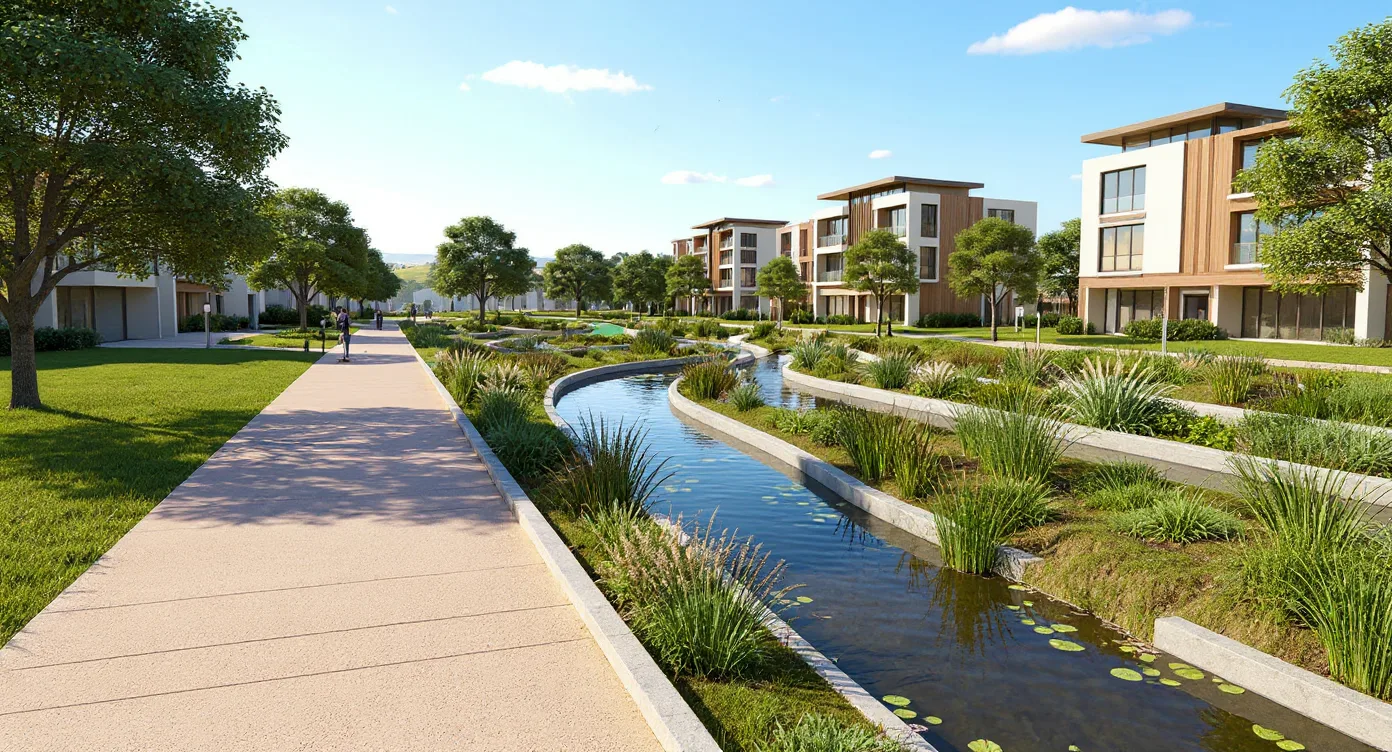
Grounded in a participatory co-design process involving local communities, government authorities, businesses, and financial institutions, three priority zones were selected: Menengai, the Nakuru Central Business District (CBD), and Njoro, with full completion of technical and cost-benefit feasibility analyses. The proposed plans are anchored in four complementary pillars: ecological restoration, nature-based drainage, ecological buffer zones, and measures to strengthen urban resilience. Instead of relying solely on conventional concrete canals, the sponge city paradigm deploys green infrastructure—including urban wetlands, rain gardens, permeable pavements, restored river corridors, and water-sensitive public spaces—to absorb, store, naturally filter, and slowly release runoff, thereby mitigating flood hazards, recharging groundwater aquifers, and enriching biodiversity.
The Nakuru project exemplifies the efficient Netherlands model of integrated climate adaptation, where joint multidisciplinary teams generate actionable, socially inclusive, and financially bankable solutions rather than merely exporting rigid engineering packages. The convergence of landscape architecture, hydraulic engineering, governance, and economic structuring has positioned these interventions on the verge of bankability. Citing international benchmarks integrated into the project framework, ecosystem-based approaches can substantially curb the exorbitant capital costs of infrastructure renewal while simultaneously elevating urban livability.
Exclusive Analysis by the Water Insight Hub Team
The paradigm shift from conventional gray engineering to green, nature-based infrastructure stands as one of the most prominent trends in modern doctrines of hydrological crisis management worldwide. As analyzed in publications by the Water Insight Hub, dense urban expansion minimizes soil permeability and severs natural hydrological flow paths. The Nakuru Sponge City model proves that urban runoff management should no longer be defined by the construction of wide concrete storm drains designed for rapid discharge; rather, comprehensive water resource management requires integrating the retention capacity of natural basins with intra-urban absorption networks, transforming destructive flash floods into opportunities for aquifer recharge.
The intelligent integration of landscape design and value engineering with advancements in water technology has transformed drainage works from costly, single-purpose structures into multifunctional ecological assets. Deploying innovative technologies such as permeable pavements, phytoremediation through engineered vegetative beds, and hydrodynamic monitoring systems planned across Nakuru’s three focal zones aligns squarely with the conceptual framework of water-adaptive cities. This approach demonstrates that investing in nature-compatible solutions not only optimizes lifecycle costs compared to conventional concrete pouring, but also delivers measurable improvements in water quality and passive physicochemical treatment before runoff reaches recipient water bodies.
The Middle East and North Africa (MENA) region, simultaneously confronting severe water scarcity and catastrophic flash floods triggered by precipitation anomalies, can draw profound lessons from the collaborative architecture of the Nakuru project. The successful execution of such initiatives is unattainable without establishing inclusive frameworks within water governance and mobilizing private and institutional capital. Emulating ecosystem restoration and ecological buffer strategies can assist MENA metropolises in embedding artificial groundwater recharge networks directly into urban fabrics, rather than losing billions of cubic meters of stormwater runoff annually to coastal outfalls and desert sinks.
Across the MENA region, where devastating seasonal floods and chronic urban inundation inflict immense recurring damage on municipal infrastructure, the sponge city framework represents an urgent technical and strategic imperative. Urban hydraulic engineering across the region remains largely trapped in rigid, conventional concrete canalization, while underlying regional aquifers suffer from catastrophic depletion. Implementing projects analogous to Nakuru—through bioretention cells, constructed wetlands, and river corridor revitalization—will not only attenuate peak flood discharges, but will also yield tangible volumes of renewable water to recharge severely stressed groundwater reserves.
Ultimately, the outcomes of the Nakuru project confirm that climate resilience must not remain confined to passive defense; urban planning leveraged through water creates a fertile foundation for ecological integrity, local job creation, and sustainable economic vitality. As this initiative orchestrated with the Dutch consortium demonstrates, formulating nature-based technical blueprints in tandem with rigorous financial modeling and cost-benefit validation is an indispensable prerequisite for securing institutional buy-in and attracting sustainable environmental capital.
 Official Email of the Water Insight Hub: