
Development of Bluebarrier Treatment Trains in the UK Through Strategic Partnership Between Curio and Ozcon
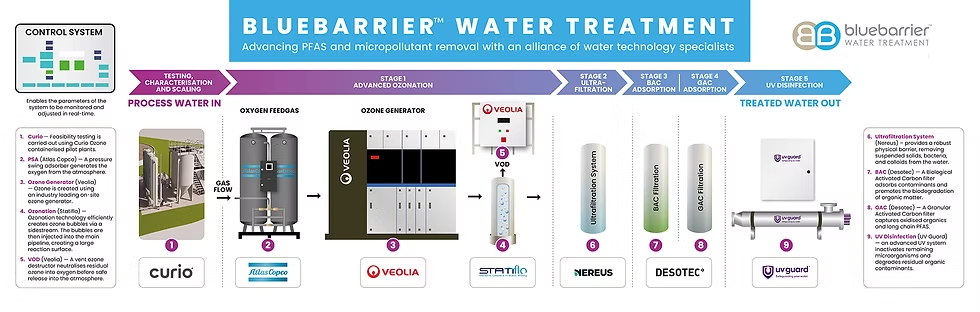
This content is a translation and analysis based on an article published by the analytical news platform Water Briefing. Curio Water and Ozcon have formed a strategic agreement to develop and deploy the next generation of treatment trains under the Bluebarrier brand across UK water facilities. A treatment train refers to a sequential series of diverse treatment processes and technologies (such as combining ozonation, UV, and filtration) linked in sequence like train cars to remove various contaminants from water stage by stage.
Birmingham-based Ozcon, operating from Cranfield University Technology Park, brings technical expertise in integrated ozone-based water treatment systems into Curio’s expanding portfolio.
This partnership specifically targets the neutralization of micropollutants and recalcitrant compounds, such as persistent chemicals, across diverse water matrices.
Beyond core water treatment, the scope of this collaboration extends to the food and beverage industry as well as industrial odor and volatile gas emissions control.
Birmingham-based Ozcon will join Curio Water at the Cranfield University Technology Park to inject industry-leading knowledge in integrated ozone-based water treatment systems across various sectors into Curio’s expanding portfolio.
Ozcon will support new and existing ozone applications for Curio; this step builds upon the company’s 2025 activities in commissioning the UK’s first ozone-based micropollutant removal facility in partnership with Severn Trent, thereby accelerating the deployment of dedicated micropollutant abatement systems across multiple sites.
Curio had previously established multiple strategic partnerships with Nereus, Desotec, and Atlas Copco, alongside its long-standing collaboration with Veolia Water Technologies. Collectively, these ties have established an extensive alliance of engineering expertise across ozonation, ultraviolet (UV) radiation, and advanced filtration within Curio, at a time when international attention is increasingly focused on confronting challenges such as PFAS: The Silent Threat in Water Resource Management, microplastics, and other persistent pollutants.
The collaboration with Ozcon also delivers specialized knowledge and capabilities for applications and industries beyond Curio’s primary water treatment business, including hygiene in food and beverage production as well as air, flue gas, and odor abatement systems.
Howard Marles, Founder and CEO of Curio Water, stated:
“We are delighted to partner with Ozcon Environmental, an acknowledged specialist in the field with a proven track record delivering ozone systems to some of the world’s largest companies across diverse applications and industries. Deploying ozone as part of a tailored treatment train to tackle micropollutants and PFAS across diverse water matrices and multiple sectors requires advanced engineering data and insight, which the Ozcon team will provide.”
Isa Tanriverdi, Founder of Ozcon, stated:
“We are thrilled to be collaborating with Curio on the urgent challenge of persistent pollutants across UK waters. Our drive to deliver engineering-led applications tailored to specific issues aligns perfectly with Curio’s vision, and we look forward to supporting their ongoing work in micropollutant removal and other operational ozone capabilities across the UK.”
Special Analysis by the Water Insight Hub Team
The drive of UK companies toward specialized alliances in advanced oxidation technologies reflects the tightening of wastewater discharge and water supply standards across international bodies. The strategic focus on multi-stage treatment trains to eliminate recalcitrant contaminants, such as per- and polyfluoroalkyl substances (PFAS), indicates that conventional treatment plant methodologies have reached an impasse. In line with the findings discussed in Emerging Pollutants: The New Challenge in Water Resources Management, the synergy of hybrid systems combining ozone, UV radiation, and carbon filtration represents the only reliable mechanism for breaking down recalcitrant molecules at an industrial scale.
Curio’s previous alliances with industry players such as Nereus, Desotec, and Atlas Copco, combined with high-grade equipment support, delineate a growing trend toward centralized engineering specialization. As detailed in the analytical frameworks presented by the Water Insight Hub platform, moving away from single-unit technologies toward multi-barrier treatment trains allows operators to customize systems for varying feedwater qualities. Consequently, merging process knowledge with Ozcon’s specialized equipment at the Cranfield Technology Park reduces operational risk during infrastructure upgrades to a minimum. Relying on advanced water technology at this scale minimizes project failure rates compared to legacy methods—an operational imperative highlighted in the analysis of Lessons from the CVWRF Project Setbacks regarding infrastructural resilience.
In the arid climate of the Middle East and North Africa (MENA) region, where direct and indirect wastewater reuse plays a crucial role in mitigating water stress, the accumulation of persistent toxic compounds poses a critical threat to soils and groundwater aquifers. Paralleling the deployment of Veolia’s membrane technologies across global projects, integrating membranes with ozone-based oxidation serves as an indispensable prerequisite for any sustainable water recycling program. Thus, deploying multi-barrier trains for chemical-laden wastewater across the MENA region’s oil and petrochemical industries will play a vital role in curbing the depletion and contamination of scarce freshwater resources.
The heavy burden of untreated industrial effluent discharges across industrial basins in the MENA region underscores the urgent necessity of adopting next-generation advanced oxidation systems. Conventional treatment facilities in the region are often ill-equipped to eliminate pharmaceuticals, pesticides, and persistent industrial derivatives due to the absence of resilient chemical degradation units. As highlighted in analytical reports, such as those evaluating Energy-Positive Wastewater Treatment Plants and detailed examinations of Innovative SIX Treatment Technology in Florida: A Leap in PFAS Removal, heavy industries across the MENA region—including steel and petrochemicals—must transition toward integrated treatment trains featuring deep ozonation to achieve Zero Liquid Discharge (ZLD) mandates.
The expansion of Curio and Ozcon’s water treatment technologies into auxiliary fields, such as food industry safety, demonstrates the blurring boundaries between water stewardship and core industrial production lines. The published operational metrics regarding their multi-site collaborations and joint delivery with utilities like Severn Trent validate the macro-scale efficiency of these solutions. With the worldwide proliferation of stringent regulatory standards for micro-contaminants, hybrid treatment trains have evolved from an optional technological preference into an essential, non-negotiable imperative.
 Official Email of the Water Insight Hub: