
AI in the Water Sector: Moving from Traditional Management to Data-Driven Governance
In an era where escalating water scarcity and climate volatility severely challenge the resilience of critical infrastructure, traditional resource management models are no longer viable. Today, Artificial Intelligence (AI) is no longer a luxury—it is an indispensable necessity for survival, operational efficiency, and sustainability in the global water industry.
The intersection of “Data” and “Drops” is unlocking unprecedented horizons in water technology. Imagine distribution networks that can actually “communicate” with operators. Advanced Machine Learning algorithms can now accurately forecast consumption patterns, pinpoint hidden leakages before catastrophic pipe bursts occur, and drastically minimize Non-Revenue Water (NRW). Within treatment plants, Digital Twins and smart automation monitor chemical and physical processes in real-time, optimizing energy consumption while guaranteeing the highest water quality standards.
Here at the Water Insight Hub, we provide a gateway to this massive digital transformation. This dedicated section brings together a curated collection of analytical reports, global market trends, and deep technical insights. Our goal is to demonstrate how AI, the Internet of Things (IoT), and Big Data are actively redefining the future of water security, both locally and globally.
Join us as we explore and shape the blueprint of this technological revolution.

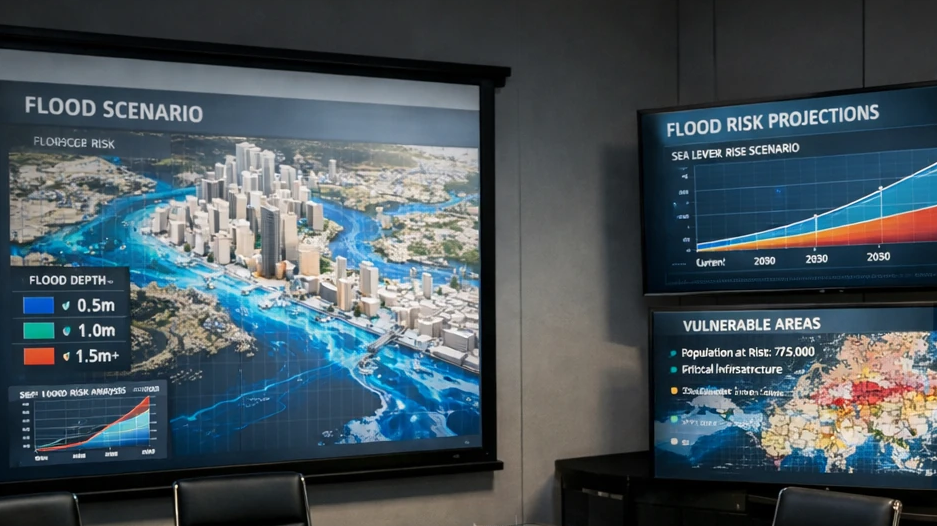
Technological Revolution in Iran’s Water Sector: Simultaneous Review of Two Achievements in Flood Prediction and Solar Desalination
This report presents an inspiring picture of a technological revolution in Iran’s water sector, where artificial intelligence and ...

AI and the Future of Water Resource Management; From Smart Assistants to Autonomous Agents
The latest IWA report emphasizes that #digitalization is no longer optional—it is the only way for network survival. We are ...

The Future of Water Engineering: How Do Large Language Models (LLMs) Manage the Water Crisis?
The next transformation in water engineering has quietly begun Not through larger dams, but by integrating ...
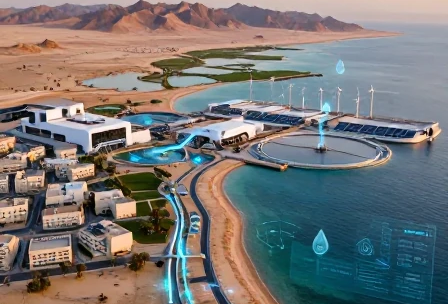
Water Technology 2030: The ‘Internet of Water’ Revolution and the Transition to Smart, Decentralized Systems for the Salvation of the Middle East – An Analytical Note
Water Technology 2030: The ‘Internet of Water’ Revolution and the Transition to Smart, Decentralized Systems for ...
The Algorithm Revolution in Earth’s Arteries: A Comprehensive Strategy for AI Implementation in the Water and Wastewater Industry
The water crisis is no longer a distant projection for the future; it is an immediate reality gripping modern civilization. Unprecedented climate volatility, rapidly depleting aquifers, and aging distribution infrastructure have combined to make water resource management the most complex engineering challenge of the 21st century. In this new era, traditional paradigms focused strictly on “structural management” and “reactive post-incident responses” have fundamentally lost their efficacy.
Today, the systematic integration of operational processes with cutting-edge layers of water technology and digitalization represents the only viable path for infrastructural survival. In this comprehensive technical analysis, Water Insight Hub dissects the scientific and practical dimensions of deploying Artificial Intelligence in the water industry far beyond mere generalities. We explore everything from sensory data ingestion layers to macro-level managerial decisions powered by deep neural networks.Chapter 1: The Raison d’Être and Critical Necessity of AI in Water Governance
Why must the water sector—historically one of the most conservative infrastructure industries in the world—inevitably embrace Artificial Intelligence? The answer lies in “complexity.” Modern hydraulic systems feature an astronomical number of interconnected variables, making manual or traditional analytical evaluation practically impossible. AI operates not as a luxury tool, but as a “central nervous system” for intelligent asset management.Chapter 2: Dissecting Smart Leak Detection and Non-Revenue Water (NRW) Mitigation
One of the greatest operational tragedies in the utility sector is “Non-Revenue Water”—treated water produced at a high financial and environmental cost that leaks into the ground before ever reaching the consumer’s tap. Artificial Intelligence has revolutionized this domain across three distinct operational tiers:1. Advanced Acoustic Analytics
Internet of Things (IoT) acoustic sensors deployed across the reticulation network continuously record acoustic profiles within the pipelines. AI algorithms can distinguish the standard sound of hydraulic flow from the faint, high-frequency “hiss” of microscopic leaks. Convolutional Neural Networks (CNNs) excel at isolating these precise leak signatures, filtering out heavy ambient background noise in dense urban environments.2. Dynamic Pressure Management
A vast majority of structural pipe failures are triggered by transient pressure spikes (water hammer) or excessive pressure maintained during low-demand nocturnal hours. By analyzing real-time consumption patterns, AI dynamically modulates Pressure Reducing Valves (PRVs), ensuring that grid pressure is constantly maintained at an optimized threshold. This single intervention can extend network asset lifespans by up to 30%.3. Mass Balance Algorithms
By cross-referencing real-time telemetry from storage reservoir outflows with smart consumer meters, AI algorithms execute high-fidelity mass balance calculations. This allows utilities to pinpoint zones suffering from hidden anomalies, background leaks, or unauthorized consumption down to the exact square meter. This marks the end of arbitrary visual inspections and the beginning of precision network surgery.Chapter 3: AI in Treatment Facilities: Optimizing Chemistry and Energy
Water and wastewater treatment plants represent some of the largest consumers of energy within municipal infrastructure. Deploying AI in the water industry within these facilities goes far beyond basic automation. In the aeration process—which typically accounts for the largest share of electricity consumption in wastewater treatment—AI models ingest real-time data to predict incoming pollutant levels (Influent Load). The system then modulates oxygenation rates on a millisecond scale. This predictive approach reduces energy expenditure by up to 25% while ensuring effluent quality remains strictly compliant and exceptionally stable.Chapter 4: Intelligent Hydrology and Macro Climate Forecasting
Historically, the management of dams and catchment basins relied on classical probabilistic models and historical baselines. Today, AI integrates diverse data streams—including satellite telemetry (such as GRACE missions), meteorological radar, and river gauge sensors—to generate highly accurate hydrological models.- Predictive Flood Warning Systems: Providing hyper-localized, early flood warnings with extended lead times, directly preserving lives and safeguarding downstream infrastructure.
- Snowmelt Runoff Estimation: By analyzing the optical and thermal spectra of satellite imagery, AI calculates the exact water equivalent locked within mountain snowpacks, optimizing reservoir release strategies ahead of seasonal shifts.
- Aquifer Management: Tracking land subsidence rates and forecasting groundwater table depletion to prevent the permanent ecological death of critical agricultural plains.