

Waves of Change: A Conceptual Framework for Transforming Water Engineering through LLM-based Multi-Agent Systems (LLM-MA)
This report is the “Water Insight Hub’s” reading of the paper “Making waves: A conceptual framework exploring how large language model-based multi-agent systems could reshape water engineering” published in the prestigious journal “Water Research”. The authors of this article are Seyed Hossein Hosseini, Babak Zolghadr-Asli, Henrikki Tenkanen, Kaveh Madani, Mir A. Matin, Ibrahim Demir, Avi Ostfeld, Vijay P. Singh, and Dragan Savic. Since the original paper has a highly technical and academic tone, we at this center have aimed to report its content in a more fluid and understandable way for the professional community.
Introduction: The Evolution of Water Engineering from Ancient Qanats to Modern AI
The concept of water engineering serves as an umbrella term for a wide range of long-standing practices including infrastructure design, system management, operational maintenance of water systems, and other elements that have supported the development and functioning of societies throughout history. Although the field has evolved from early manual systems like qanats and canal maintenance to today’s automated networks, the fundamental goal of water resources management has remained remarkably unchanged. However, today the nature of this profession is shifting through the automation of routine tasks and the redefinition of decision-making processes. Advances in Artificial Intelligence (AI), interpreted as the capacity of machines to simulate human cognitive functions such as learning, reasoning, and adaptation, can potentially and significantly facilitate water engineering tasks such as data collection, modeling, and decision-making processes. While traditional engineering relies primarily on humans for design, planning, and execution, today’s water engineering has the potential to become increasingly AI-assisted. While significant innovations in AI are emerging, their widespread adoption in practical applications remains limited and is evolving gradually. Among these innovations are Machine Learning (ML) techniques that enable systems to identify patterns and infer directly from data, reducing dependence on pre-defined rules. In this domain, Deep Learning (DL) models—multi-layered neural networks capable of capturing complex relationships—can, for example, predict floods before they occur and support “smart” reservoir operations by automatically adjusting releases in real-time, offering promising pathways for future practical applications. These techniques have also enabled water engineers to predict leaks in water distribution networks, thereby minimizing the need for extensive human inspection and emergency repairs. By processing data collected from hard-to-reach areas through remote sensing, AI-equipped models can assess water quality and enable experts to monitor environmental conditions remotely and with high efficiency. As noted, the influence of AI across all sectors of water engineering has been steadily expanding, and its impact is likely to become increasingly profound in practice.Key Highlights of the Paper:
- LLM-MA systems can enhance water engineering by improving data integration, monitoring, and decision-making.
- Specialized agents can support groundwater monitoring, irrigation planning, reservoir management, and post-disaster response.
- Key challenges include data accessibility, computational requirements, bias, model hallucinations, and water governance issues.
The Rise of Large Language Models (LLMs) in Water Technology
The versatility of Large Language Models (LLMs) as generative AI—referring to AI systems capable of creating new and original content by learning from existing data and interacting with diverse systems—has opened opportunities for developing smarter and more adaptable systems. Specifically, Large Language Model-based Multi-Agent (LLM-MA) systems are an extension of this evolution, facilitating the coordination of multiple specialized agents to collaboratively solve complex problems across various domains. With natural language as the interface and the interaction of goal-oriented agents, LLM-MA systems have emerged that are smarter than their collective components; a group of expert agents that coordinate and delegate tasks to independently execute a complex process—for example, responding to technical queries in a wastewater treatment plant and water quality enabled by agent collaboration. Through such architectures, agents can communicate and access external tools, resources, and services to support their functions. Furthermore, as a case study in a water distribution network research, an LLM-MA system has been introduced featuring a “Coordinator Agent” that synchronizes with three specialized agents: a “Knowledge Agent” for hydraulic reasoning, a “Modeling Agent” for interacting with external simulation tools, and a “Coding Agent” for automated code generation and execution. Recently, LLMs and AI agents have also been utilized for flood mitigation, water resources management, water quality assessment, and water distribution networks.Architecture and Workflow of Multi-Agent Systems (LLM-MA)
LLMs are advanced deep learning models developed using large-scale datasets comprising text from diverse sources such as academic publications, books, and online materials, enabling them to interpret and generate language much like human communication. While LLMs have impressive capabilities for Natural Language Processing (NLP) and text generation, their potential can be significantly amplified when integrated into multi-agent (MA) systems, allowing for more dynamic, distributed, and context-aware problem-solving.Practical Applications of Multi-Agent Systems in Water Management
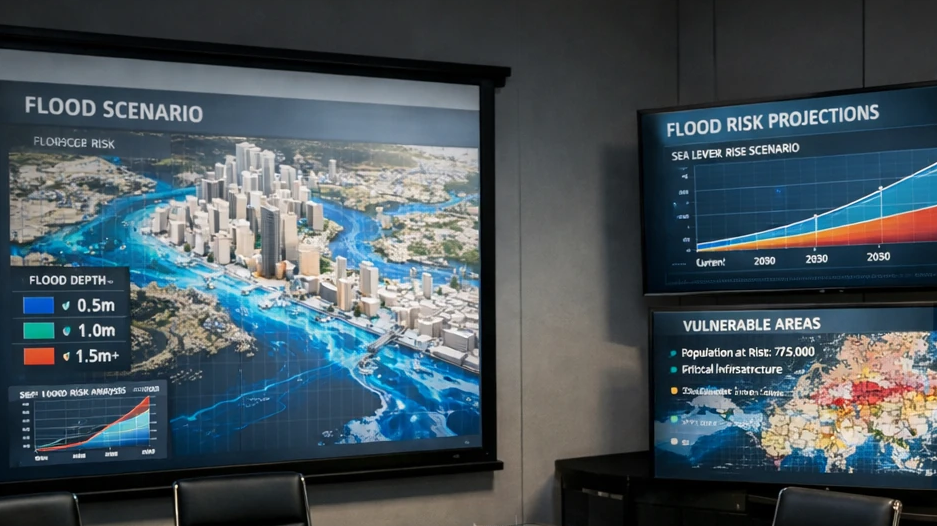
LLM-based multi-agent systems can play diverse roles throughout the water management cycle. These systems operate beyond simple chatbots, acting as specialized intelligent agents. Data Analysis and Water Resource Monitoring (Groundwater and Surface Water): In the data analysis and integration sector, data retrieval, pre-processing, and RAG-enabled (Retrieval-Augmented Generation) reasoning agents can perform real-time data collection from diverse sources (such as sensors, APIs, and IoT), leading to improved data quality and context-aware analysis. Also, in groundwater and surface water monitoring, monitoring, verifying, and quota-enforcement agents enable automated tracking of withdrawals, adaptive allocation between sectors, and early detection of anomalies. This can create a transformation in water security and the prevention of unauthorized extractions. Flood Management, Urban Runoff, and Agriculture: In the field of urban runoff and flood management, intelligent agents connected to hydrological models allow for the analysis of various scenarios. These systems make risk assessment more accurate and facilitate coordination between organizations during flood emergencies by simulating key “What-if” questions. Simultaneously, in irrigation planning and soil-water-plant optimization, meteorological-soil agents and predictive reasoners enable dynamic adjustment of irrigation schedules based on precipitation forecasts and soil moisture, significantly contributing to improved water use efficiency.Recommendations and Practical Considerations for Safe Implementation
The flexibility of agents in LLM-MA systems allows for the exchange of insights without the need to transfer raw data, thereby supporting data privacy. One effective method to achieve this is Federated Learning, where agents virtually come together to train a shared model using local data, while transmitting only encrypted model updates instead of raw readings or datasets. This decentralized approach maintains data confidentiality while enabling collaborative learning across distributed nodes. Another technique for preserving privacy is Differential Privacy (DP), which involves injecting statistical noise into aggregated outputs.Special Analysis by Water Insight Hub Team
1. Transitioning from Static Models to Dynamic Agents in the MENA Region: The findings of this paper represent a fundamental paradigm shift crucial for the Middle East and North Africa (MENA), a region facing some of the world’s most acute water scarcity. Historically, water management in MENA has relied on classical hydrological models that often struggle with data gaps and time-consuming calibrations. LLM-MA systems can bridge the “sparse and unstructured data” gap prevalent in many regional countries. Much of the vital water information in the region exists in text-based reports, administrative minutes, and non-numerical data. This technology can transform this “gray data” into actionable knowledge for urgent decision-making. 2. The Role of Negotiating Agents in Regional Water Diplomacy: One of the most compelling aspects for the Middle East is the mention of “Negotiating and Role-Playing Agents.” In the tense atmosphere of transboundary water disputes (e.g., the Nile, Tigris-Euphrates, or Jordan River basins), conflicting interests between nations and sectors (agriculture vs. industry) are extreme. Generative AI can model “win-win” scenarios by simulating negotiations and considering the varied objectives of each stakeholder without emotional bias. These digital “water diplomats” could provide objective frameworks for water governance that might otherwise be obscured by political tensions. 3. Data Sovereignty and Cybersecurity Challenges in the Arab World and Beyond: Analysts at the Water Insight Hub believe that implementing these systems in the MENA region faces the hurdle of “Data Sovereignty.” Given that water resources are strategic assets, security concerns regarding cloud-based AI and foreign platforms are significant. Therefore, developing localized LLM architectures or utilizing private infrastructures that keep data within national borders is a prerequisite for operationalizing this innovation within ministries and water authorities. Without a unified and secure data infrastructure, even the most advanced agents will be prone to “hallucinations” or errors in high-stakes decisions.For more details, we recommend interested readers to study the original article.
 Official Email of the Water Insight Hub: