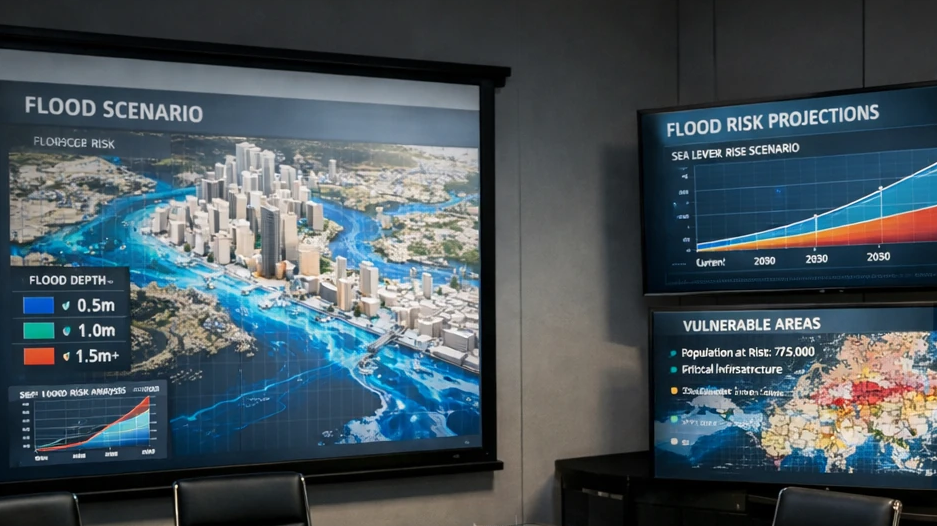
Technological Revolution in Iran’s Water Sector: Simultaneous Review of Two Achievements in Flood Prediction and Solar Desalination

This report presents an inspiring picture of a technological revolution in Iran’s water sector, where artificial intelligence and nanotechnology converge to address critical water challenges. On one front, smart machine-learning models—adapted from Swiss standards and localized for Iranian conditions—enable accurate flood prediction even in data-scarce regions, helping bridge the long-standing gap between academic research and urban decision-making. On the other, Iranian researchers have achieved a record 93% efficiency in solar desalination systems through advanced nano-engineered membranes, making desalination more sustainable, affordable, and energy-efficient. The synergy of these two breakthroughs highlights a shift toward knowledge-based, data-driven water governance and opens a new horizon for strengthening long-term water security in Iran.

Water Resource Management & Food Security: Analyzing the Nexus Approach in the Middle East

In today’s world, the sustainability of ecosystems depends on understanding the link between #Water, #Energy, #Food, and #Ecosystems. The #Nexus approach, or #WEFE_Nexus, which emphasizes this interconnection, has moved from the research level to the heart of #PolicyMaking. The experience of countries in the Arab region shows that moving beyond #SectoralManagement toward #IntegratedGovernance is the only path to confronting #ClimateChange and the #WaterCrisis.
Countries like #Egypt, the #UAE, and #Morocco, by relying on #WaterTech, #WaterRecycling, and the development of #RenewableEnergy, have managed to move Nexus projects from planning to implementation and reduce harmful interdependencies. However, challenges such as #Financing, the lack of a multi-sectoral #LegalFramework, and the gap between #ResearchCenters and #Executive bodies remain. Analyzing these experiences can help in the #Localization of successful models within the framework of #WaterGovernance and smooth the path toward #SustainableDevelopment.
For a detailed analysis of these regional experiences, visit the Water Insight Hub platform.

The Future of Water Engineering: How Do Large Language Models (LLMs) Manage the Water Crisis?

The next transformation in water engineering has quietly begun
Not through larger dams, but by integrating #ArtificialIntelligence into the heart of water decision-making.
Multi-agent systems based on Large Language Models (LLMs) can simultaneously analyze data, build scenarios, and offer policy recommendations, covering everything from floods to #Groundwater.
📌 The article’s message is clear: these systems can serve as digital collaborators for water engineers or even as neutral negotiators.
However, the lack of open data and weak #DataGovernance remain the biggest obstacles.
✅ The future of #WaterEngineering is smart; yet, it cannot be realized without data governance, transparency, and institutional trust.
For more insights on this digital shift, follow the Water Insight Hub.

Water Imports from Russia and the Virtual Water Strategy | Water Insight Hub
When an official speaks explicitly for the first time about “water imports,” it must be understood that the #WaterCrisis has moved beyond the warning phase into the phase of strategic decision-making. The Energy Minister’s remarks on importing water from neighbors are not merely a technical discussion; they signal a sensitive dilemma in #WaterGovernance: the choice between #PhysicalWater and #VirtualWater.

Priorities of the 2026 Water Conference Preparatory Meeting: From Innovation and Technology to Active Diplomacy
The preparatory meeting for the #UNWaterConference2026, held on January 26-27, 2026, in Dakar, Senegal, is recognized as a turning point in international efforts to tackle the escalating water crisis and strengthen global #WaterGovernance. The significance of this meeting lies in the fact that at the start of 2026, the international community is convening to formulate core themes and define an operational roadmap for the main conference in New York, aiming to bridge existing gaps toward achieving the Sustainable Development Goals. Given the accelerating pace of climate change, the Water Insight Hub believes that this meeting is not merely a political gathering, but a strategic platform for water professionals and policymakers to challenge traditional water resource management patterns and move toward resilient models.

Water Technology on the Verge of Semi-Autonomous Systems: A Global Exploration of Non-Linear Innovations, from Infrastructure to Decision Intelligence
Water Technology on the Verge of Semi-Autonomous Systems: A Global Exploration of Non-Linear Innovations, from Infrastructure to Decision Intelligence Introduction: Transitioning from the Mechanical Era to Liquid Intelligence Our world is undergoing a fundamental shift in how we handle our most vital resource. Water technology no longer means simply laying pipes, building dams, or mechanical […]
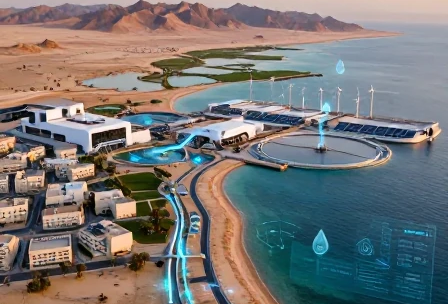
Water Technology 2030: The ‘Internet of Water’ Revolution and the Transition to Smart, Decentralized Systems for the Salvation of the Middle East – An Analytical Note
Water Technology 2030: The ‘Internet of Water’ Revolution and the Transition to Smart, Decentralized Systems for Global Salvation While the world grapples with accelerating climate change, traditional water resource management paradigms, relying on massive dam construction and water transfer, have lost their effectiveness. Today, the term heard more than ever in global scientific and managerial […]
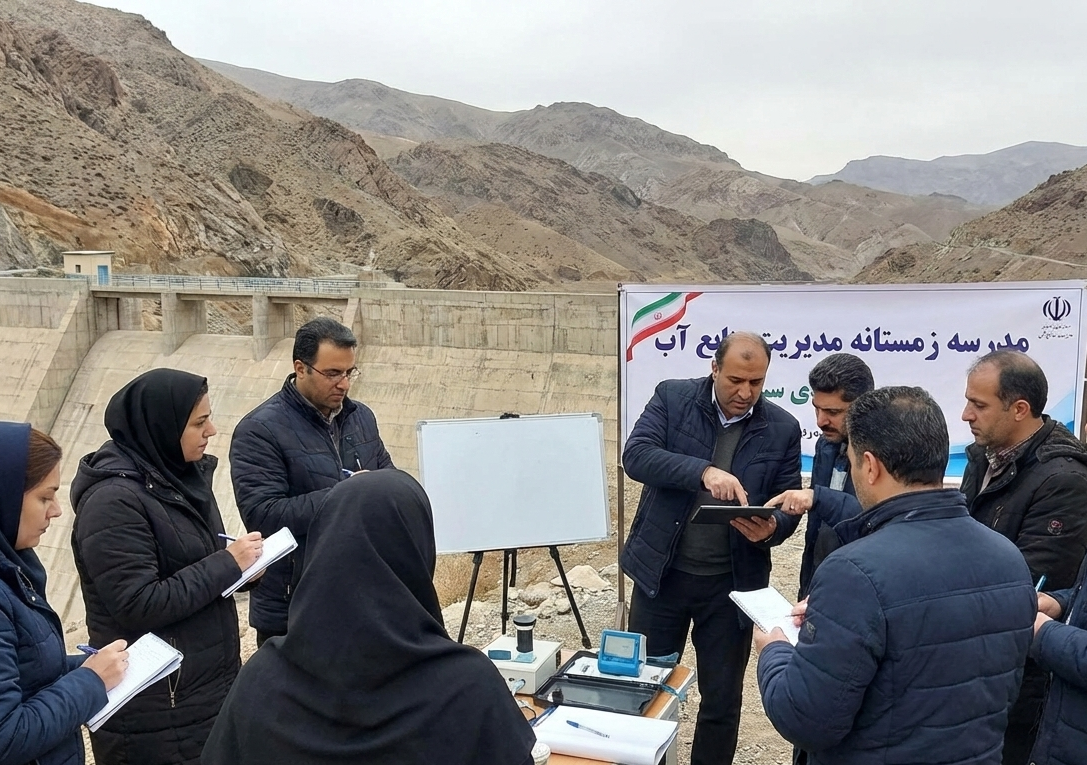
Water Crisis Alert & Education Redefined: The ‘Water and Environment Seasonal Schools
Why Seasonal Schools are Vital for the Future of Water Resource Management in the MENA Region As Winter 2025 approaches, leading water management institutions across the MENA region are launching a new series of specialized Winter Schools. These initiatives, spreading through regional water innovation hubs, are far more than mere training courses; they represent a […]