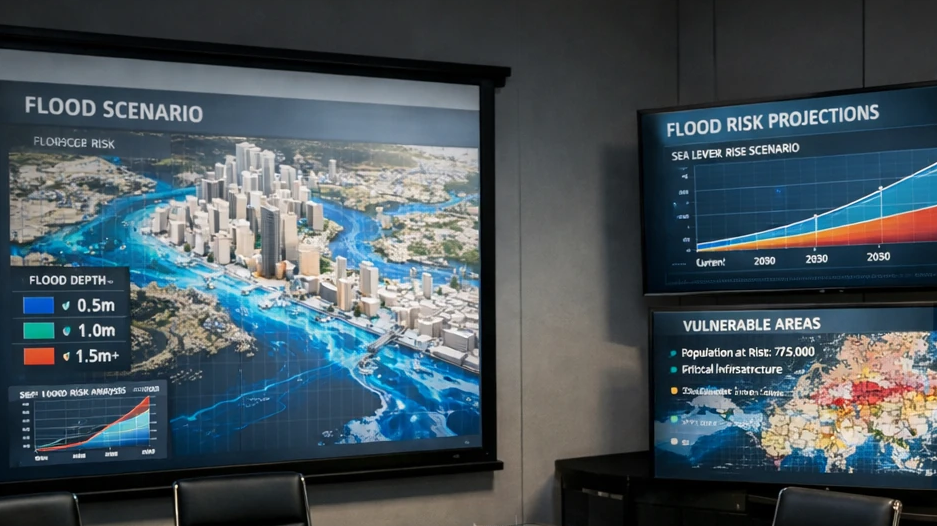
Technological Revolution in Iran’s Water Sector: Simultaneous Review of Two Achievements in Flood Prediction and Solar Desalination

This report presents an inspiring picture of a technological revolution in Iran’s water sector, where artificial intelligence and nanotechnology converge to address critical water challenges. On one front, smart machine-learning models—adapted from Swiss standards and localized for Iranian conditions—enable accurate flood prediction even in data-scarce regions, helping bridge the long-standing gap between academic research and urban decision-making. On the other, Iranian researchers have achieved a record 93% efficiency in solar desalination systems through advanced nano-engineered membranes, making desalination more sustainable, affordable, and energy-efficient. The synergy of these two breakthroughs highlights a shift toward knowledge-based, data-driven water governance and opens a new horizon for strengthening long-term water security in Iran.

AI and the Future of Water Resource Management; From Smart Assistants to Autonomous Agents

The latest IWA report emphasizes that #digitalization is no longer optional—it is the only way for network survival. We are transitioning from Generative AI to #Agentic_AI; systems that don’t just predict pipe bursts but take autonomous actions to optimize energy and reduce #NonRevenueWater.
In the new analysis by Water Insight Hub, we explore how these technologies bridge the skill gap left by retiring experts while boosting productivity by 20%. In regions facing chronic #WaterScarcity, leveraging #ArtificialIntelligence to turn scattered data into decisive management is a civilizational necessity.
We believe #innovation at this level transforms water resource management from a daunting human task into a smart, automated process. The future of #WaterGovernance relies on the convergence of digital systems and cybersecurity for critical infrastructure. To survive water bankruptcy, we must shift from reactive management to autonomous systems.

The Future of Water Engineering: How Do Large Language Models (LLMs) Manage the Water Crisis?

The next transformation in water engineering has quietly begun
Not through larger dams, but by integrating #ArtificialIntelligence into the heart of water decision-making.
Multi-agent systems based on Large Language Models (LLMs) can simultaneously analyze data, build scenarios, and offer policy recommendations, covering everything from floods to #Groundwater.
📌 The article’s message is clear: these systems can serve as digital collaborators for water engineers or even as neutral negotiators.
However, the lack of open data and weak #DataGovernance remain the biggest obstacles.
✅ The future of #WaterEngineering is smart; yet, it cannot be realized without data governance, transparency, and institutional trust.
For more insights on this digital shift, follow the Water Insight Hub.