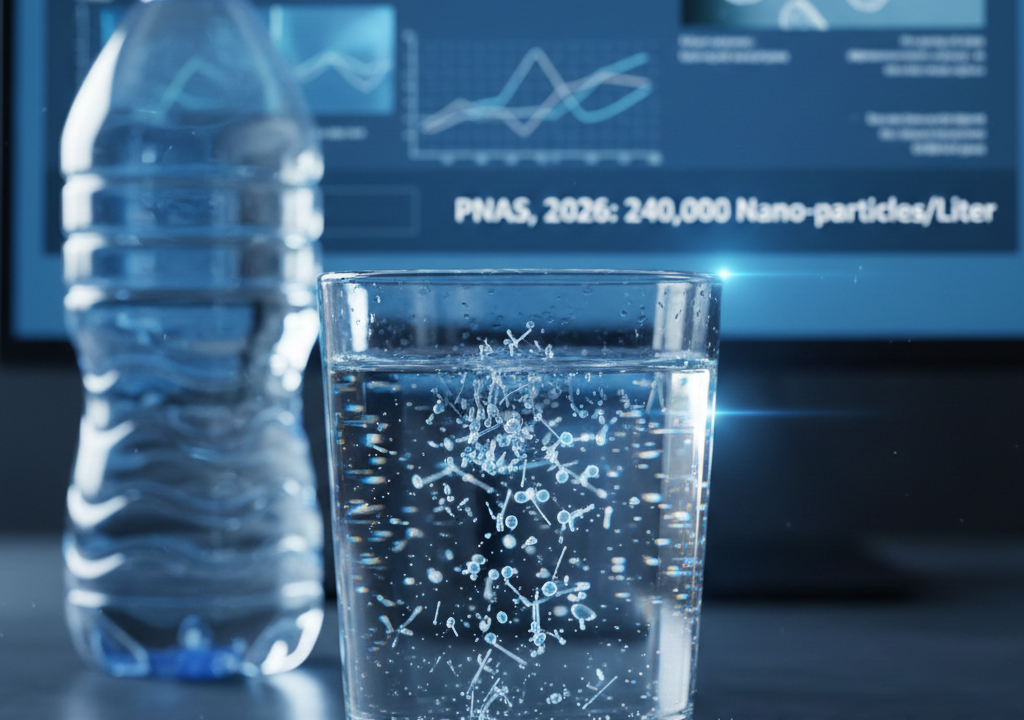

A recent study published in the prestigious journal PNAS (Proceedings of the National Academy of Sciences) reveals that the number of plastic particles in bottled water is up to 100 times higher than previous estimates, adding new dimensions to the global water crisis, particularly in the Middle East and North Africa (MENA). This research, based on advanced optical technologies, sounds an alarm for water sector specialists and policymakers; nanoplastics, due to their microscopic size, have the ability to penetrate human body tissues. In a region heavily reliant on bottled water and desalination, these novel polymeric pollutants add another layer of complexity to the concept of water security and water governance, requiring immediate attention and innovative approaches.
Key Takeaways:
- Utilization of SRS microscopic imaging technique to identify nanoplastics across seven different types of polymers.
- Identification of an average of 240,000 plastic particles per liter of bottled water, 90% of which are nanoplastics.
- Polyethylene Terephthalate (PET) and Polyamide (PA) were among the most common polymers found in samples.
- Unlike microplastics, nanoplastics have the potential to cross the blood-brain barrier due to their size (less than one micrometer).
- The necessity of revising water technology standards, desalination processes, and packaging to mitigate health risks in the region.
Modern Imaging Technology and the Revelation of Nanoplastic’s Hidden Dimensions
The research published in PNAS (https://www.pnas.org/doi/10.1073/pnas.2300582121) utilized a methodology known as Stimulated Raman Scattering (SRS) microscopy, which allows for the counting and identification of plastic particles at the nano-scale with extreme precision. Previously, water sector specialists were only able to monitor microplastics, but this new technology showed the presence of between 110000 to 370,000 particles per liter of water. This statistical leap in contaminant identification represents a deep gap between environmental reality and current traditional monitoring capabilities.
It is likely that many of these particles leak from the bottle itself or during the filtration process. Specifically, it was found that nylon or polyamide, used in water purification filters to improve quality, has itself become a major source of nanoplastic pollution. This paradox in water technology proves that modern processes, if they do not consider nano-standards, may contribute to introducing more dangerous pollutants into the consumption chain instead of solving the problem.
Challenges of Nanoplastic Penetration into the Biosphere and Public Health
The fundamental difference between microplastics and nanoplastics lies in their ability to move within the body. Particles smaller than one micrometer can pass through the digestive system or lungs into the bloodstream, and from there to vital organs such as the heart and brain. These findings double the necessity of revising water governance; current standards in MENA countries often focus on chemical and microbial contaminants, while nano-particles still have no clear place in national and international protocols.
Massive plastic production and poor waste management in the region have led to the fragmentation of these materials and their eventual leakage into groundwater and surface water resources. Innovation in producing alternative packaging materials and reforming the structure of distribution networks is the only way to confront this escalating crisis. Experts believe that without a change in production and consumption behaviors, even the most advanced water resource management systems will not be able to completely eliminate these microscopic threats.
The Gap Between Scientific Innovation and Policy-Making in Water Resource Management
The PNAS study represents a turning point in our understanding of water quality. While innovation in basic sciences is moving rapidly to detect new pollutants, the levels of decision-making and implementation in water governance often lag behind. This delay in addressing the water crisis could lead to dire consequences for public health. Over-reliance on polymers in all stages of water transport and storage is a paradigm that must be strictly reviewed.
“While microplastics are widespread in the environment, nanoplastics represent a much more serious threat to biological systems due to their extremely small size and ability to penetrate cells.” – Lead researchers in the PNAS study.
Exclusive Analysis by the Water Insight Hub Team – Water Insight Hub
The Water Insight Hub considers the PNAS results a severe warning for water resource management in the MENA region. In a region where Gulf countries, Egypt, and North Africa increasingly rely on bottled water and desalination plants to face water scarcity, the leakage of nanoplastics could turn into a national public health challenge. The region suffers from a severe water crisis that has led to the expansion of membrane filtration technologies, which research has proven may themselves be a source of these particles.
The Water Insight Hub believes in the necessity of adopting three parallel strategies: First, raising standards in water technology and requiring factories to use modern filters that minimize polymer release. Second, strengthening water governance through the establishment of regional reference laboratories capable of monitoring nano-particles. Third, stimulating innovation in packaging industries to shift toward sustainable alternatives. The water crisis in our region is not just a shortage of quantities, but a deterioration in quality due to emerging pollutants.
Attention must be paid to the fact that the culture of bottled water consumption in Arab countries is steadily increasing due to occasional lack of trust in the quality of public network water. The Water Insight Hub emphasizes that scientific data indicates high concentrations of nanoplastics in global brands, and the region is no exception. Therefore, transparency in analytical results and supporting water sector specialists to localize nano-sensors are sovereign tasks to protect water security.
The shift from traditional management to smart and technological management is a necessity that The Water Insight Hub has long advocated for. We need to formulate a “Roadmap for Water Health against Micro-pollutants.” Without a comprehensive vision linking innovation to water resource management, it will be impossible to face invisible threats. The Water Insight Hub is ready to collaborate with universities and the private sector to create a platform for knowledge exchange and turn the water crisis into an opportunity for leadership in nano-purification technologies.
Frequently Asked Questions
What is the fundamental difference between microplastics and nanoplastics?
Microplastics are particles ranging in size from 5 mm to 1 micrometer, while nanoplastics are smaller than 1 micrometer. The importance lies in the fact that nanoplastics can penetrate cell walls and reach the bloodstream and internal organs, raising intense concerns among water specialists regarding long-term public health.
Why did the PNAS study show much higher numbers than previous research?
Previous research suffered from technical limitations that prevented the observation of nano-particles. Using the new SRS microscope technique, researchers were able to monitor what was previously hidden. Results showed that 90% of particles in bottled water are nanoplastics, completely changing our understanding of the scale of pollution in water resource management.
Does boiling water or using home filters eliminate nanoplastics?
Ordinary home filters are often unable to trap nano-scale particles, and some may even add plastic particles. Preliminary studies suggest that boiling “hard” water may trap some particles within calcium deposits, but this is not a definitive solution. The best path is reforming water technology industrially and reducing reliance on plastic.
What is the role of water governance in confronting nanoplastic pollution?
Water governance must update quality standards based on new scientific discoveries, impose strict regulations on packaging industries, and support innovation in desalination plants. In the MENA region, the Water Insight Hub advises that policies must focus on microscopic quality alongside securing physical quantities.