
Technological Revolution in Iran’s Water Sector: From Smart Flood Prediction with Swiss Models to Nano-Desalination with 93% Efficiency
In the current era, the confrontation between “extreme water crises” such as devastating floods and “severe water resource shortages” requires solutions that transcend traditional methods. The Water Insight Hub has always believed that integrating emerging technologies with local knowledge is the key to solving complex water governance dilemmas. In this comprehensive report, we review two major scientific achievements recently published by Mehr News Agency. The first report, titled “Flood Prediction via Machine Learning; Implementation of a Leading Swiss Project in Iran” by Shabnam Derakhshan, discusses a successful international collaboration to bridge the data gap in flood management. The second report, titled “Iranian Researchers Raise Solar Desalination Efficiency to 93%” by Mahtab Jabouk, recounts a staggering advancement in the field of desalination using renewable energy. Integrating these two approaches provides a clear picture of the ability of water sector specialists to enhance water security.Key Highlights and Pivotal Achievements
- Design of “Siavash” and “Farhad” Smart Models: Utilizing Machine Learning (ML) to predict floods in regions lacking hydrological data.
- Localization of Swiss Standards: Formulating guidelines for flood hazard maps based on collaboration between K. N. Toosi University of Technology and the University of Applied Sciences Rapperswil (OST).
- Breaking Desalination Efficiency Records: Achieving 93.5% efficiency in solar desalination plants by modifying polymer membrane surfaces.
- Nanotechnology at the Service of Water: Using carbon nanoparticles and altering the structure of PVDF membranes to increase light absorption and wetting resistance.
- Diagnosis of Urban Planning Errors: Precise analysis of hazard maps in the “Pol-e Dokhtar” region, proving fatal errors in the placement of urban infrastructure relative to flood zones.
- Sustainability Against Contaminants: Producing membranes with an “Omniphobic” surface resistant to surfactants with a long operational lifespan.
Smart Flood Management: Bridging the Gap Between Knowledge and Implementation with Swiss-Iranian Models
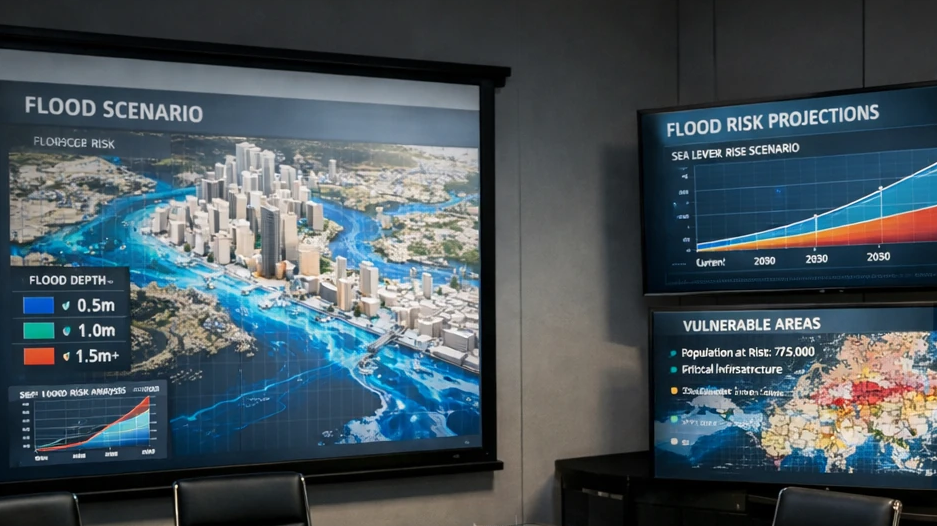
One of the fundamental and chronic challenges in the water governance structure is the deep gap between technical knowledge produced in universities and the operational processes of policymaking and urban decision-making. This disconnect has led many valuable studies to remain mere theoretical recommendations locked in drawers. In this context, the formulation of localized manuals for preparing flood hazard maps was defined as a main axis of international cooperation, aiming to inject specialized expertise into the decision-making cycle of municipalities and crisis management organizations. Mohammad Javad Ostad-Mirza-Tehrani, Director of the Water Matters Laboratory at K. N. Toosi University of Technology, explained the motives behind this project to Mehr News, citing his personal experience with the 2019 floods:“The truth is that my main motivation for seriously entering the subject of flood hazard maps was the occurrence of the 2019 floods in Aq Qala and Pol-e Dokhtar; floods that coincided with my return to the country, where we faced their consequences firsthand.”Initial analyses showed that the status of flood maps was extremely concerning. Out of more than 72,000 kilometers of rivers, only about 2,000 kilometers had zoning maps. More unfortunately, existing maps were not prepared systematically, making them unsuitable for conversion into hazard maps for crisis management. This scientific vacuum led to the formation of a strategic joint project with (OST) University in Zurich, Switzerland.
Localization of Standards and Diagnosis of the “Pol-e Dokhtar” Disaster
The research team, using recognized Swiss manuals and considering administrative and local requirements, developed a comprehensive guide for preparing hazard maps. This framework was implemented pilot-style in two completely different regions: the lowland “Aq Qala” region and the mountainous “Pol-e Dokhtar” region. The results proved the possibility of moving from theoretical documents to operational decision-making tools. Ostad-Mirza-Tehrani described the analysis results in the city of Pol-e Dokhtar as shocking; analyses showed that buildings and critical infrastructure were erected exactly at the points with the highest level of flood risk. This proves how the absence of binding maps turns urban development into a factor that exacerbates losses. This project was awarded the title of the selected project by the Swiss Leading House for Science & Technology.The Emergence of “Siavash” and “Farhad” Smart Models
These efforts resulted in the design and modeling of two smart systems, “Siavash” and “Farhad,” which rely on Machine Learning (ML) and Deep Learning (DL). These systems allow for the production of reliable hazard maps even in basins suffering from a severe lack of data.Revolution in Desalination: 93% Efficiency via Nanotechnology
On another front of water technology, researchers at Isfahan University of Technology succeeded in recording a new record in solar desalination efficiency. This achievement relies on modifying the structure of (PVDF) membranes and adding carbon nanoparticles, creating a porous surface that effectively absorbs sunlight and converts it into heat for water evaporation. This technology, known as “Photothermal Vacuum Membrane Distillation” (PVMD), is an advanced path for securing fresh water sustainably. The developed membranes are characterized not only by their high efficiency but also by their ability to withstand chemical contaminants for 540 minutes without any drop in performance. Laboratory results showed that the rougher and more porous the surface, the better the light absorption and molecular transition. For example, a membrane with 32.6% porosity recorded a staggering evaporation efficiency of 93.5%, compared to ordinary membranes that did not exceed 60.7%.Special Analysis from the Water Insight Hub Team – Focused on the MENA Region
The integration of these two breakthroughs carries a clear message for decision-makers in the Middle East and North Africa (MENA) region: “The transition from concrete structures to knowledge-based structures.” The MENA region is passing through a historical turning point where traditional solutions based solely on dam construction are no longer capable of facing complex water crises. The flood prediction project showed that the problem in our region is not always a lack of infrastructure, but rather the absence of “data-driven vision.” Using Artificial Intelligence and models like “Siavash” and “Farhad” heralds an era where “software” takes precedence over “hardware,” transforming flood management from a post-disaster reaction to anticipation and prevention. On the other hand, the achievement in nano-desalination is a direct response to the challenge of water and food security in regional countries that suffer from water scarcity yet enjoy solar abundance. Achieving 93% efficiency using solar energy changes the cost-benefit equation in favor of the environment and the economy. It allows for the “decentralization” of water supply, enabling the conversion of saline water into drinking water at any sunny, remote point without the need for expensive transmission networks. In conclusion, the Water Insight Hub believes that localizing these technologies and developing them to suit the climate and challenges of the MENA region is the only way to save the region from “water bankruptcy” in the coming decade.
These models are software tools based on artificial intelligence and machine learning, developed by Iranian researchers. Their primary function is to predict flood behavior and produce flood hazard and risk maps in regions that lack hydrometric stations and reliable historical data. By learning from patterns in similar basins and available datasets, the models can accurately identify high-risk areas and help urban managers prevent construction in flood-prone zones.
According to studies conducted in collaboration with Swiss universities, urban development in Pol-e Dokhtar took place without proper consideration of scientific flood hazard maps. The analyses show that buildings and critical infrastructure were constructed directly along main flood flow paths and in areas with the highest flood risk. As a result, the 2019 flood caused severe damage—losses that could largely have been avoided through proper urban siting and planning.
Photothermal Vacuum Membrane Distillation (PVMD) is a technology that uses solar energy to heat water and convert it into vapor. The vapor passes through a specialized membrane, while salts and impurities are left behind. The key advantage of the new achievement by Iranian researchers lies in the use of carbon nanoparticles and surface modification of the membrane, which has increased the efficiency of light-to-heat conversion and freshwater production to over 93 percent—an exceptionally high figure by global standards.
Yes. The flood prediction models have already been successfully implemented as pilot projects in two distinct regions (Agh Qala and Pol-e Dokhtar) and can be scaled up nationwide. As for the nano-enabled desalination systems, the high durability of the membranes against contaminants and the lack of need for complex high-pressure equipment (unlike reverse osmosis) make them well suited for both industrial-scale and decentralized applications, especially in remote and sun-rich regions.
 Official Email of the Water Insight Hub: